
How a Water-Activated Repair Wrap Turns Rigid in Six Minutes, and What Its Test Numbers Mean
Dip a soft fibreglass bandage in water for five seconds, wrap it round a damaged cable, and six minutes later it is a hard shell. Here is the chemistry that makes it work, and what the laboratory numbers mean on a factory floor.
Most cable protection is installed before a fault. A repair wrap is for after: the cable that was crushed by a forklift, cut by a guard edge, or worn through where it rubbed a robot base for a year. Maintenance teams in automotive plants know the choice. Replace the cable and stop the line for hours, or make a sound repair now and plan the replacement for the next shutdown.
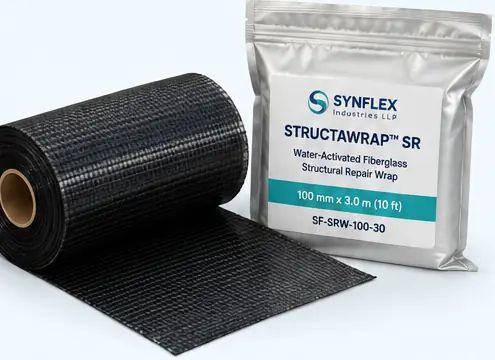
STRUCTAWRAP SR is our water-activated fibreglass repair wrap, sometimes called armour wrap or armour repair tape. You open a foil pouch, dip the roll in water for a few seconds, wrap it round the damaged section, and within minutes it hardens into a rigid shell. This article explains the chemistry behind that, and how to read its laboratory test values.
Two materials, one shell
The wrap is a composite. It has two parts, and each does a different job.
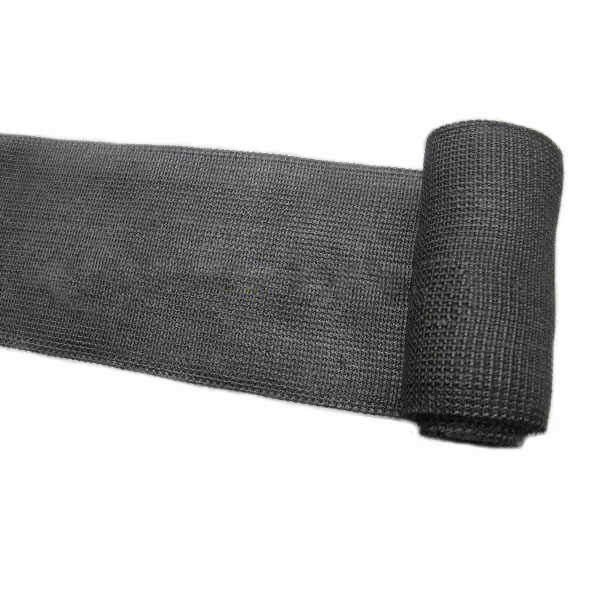
- A knitted fibreglass fabric. Glass fibre gives the cured shell its strength and stiffness. It is knitted rather than woven, so the tape stretches a little in every direction while it is wet. That is what lets it follow a cable, a joint or a tapered transition without wrinkling.
- A moisture-curing polyurethane resin. The resin coats every fibre. Uncured, it is a soft, slightly tacky paste. Once activated, it hardens and locks the fibres and the layers together into one solid shell.
Neither part would be much use alone. Glass fabric on its own is floppy. Resin on its own would be hard but brittle, and would crack at the first knock. Together they behave like the glass-reinforced plastic of a boat hull, made on site in minutes.
Why water makes it hard
The resin is based on an isocyanate prepolymer, chemically the same family used in rigid polyurethane parts. Isocyanate groups react readily with water. When the roll is dipped:
- Water reaches the resin and reacts with isocyanate groups. Each reaction releases a little carbon dioxide and forms an amine.
- That amine immediately reacts with another isocyanate group, forming a strong urea link.
- Because each prepolymer molecule carries several reactive ends, the links multiply in every direction. The paste becomes a crosslinked network, a solid that cannot melt or flow again.
Three things follow from this chemistry, and each one shows up in how the wrap must be used.
- The clock starts at the water. Once activated there is no pause button. That is why the instructions say to wrap immediately and use the whole roll once the pouch is open.
- The foil pouch matters. Humidity in the air is water too. A pinhole in the pouch, or a roll left half-used, will slowly cure in storage. Unopened, stored dry at 15–30 °C, the shelf life is two years.
- A little gas is released. The carbon dioxide can leave tiny voids between layers if the wrap is applied loosely. Pulling each turn firm and smoothing the surface with gloved hands squeezes the layers together and pushes the gas out. That is what the peel strength value later in this article depends on.
The resin also carries small amounts of helper ingredients: a wetting agent so that water soaks in evenly, a silane that bonds the resin chemically to the glass surface, and an antioxidant and stabiliser that protect it in the pouch. These are what make the difference between a shell that cures evenly and one that stays soft in patches.
Six minutes to set, thirty to handle
In independent laboratory testing, STRUCTAWRAP SR set in 6 minutes, inside the 4–8 minute window the test called for. "Set" means the wrap has stopped being workable and holds its shape. It is not yet at full strength. Allow about 30 minutes before the repair is handled, loaded or returned to service.
Like any chemical reaction, cure speed depends on temperature. On a cold winter morning in a North Indian plant, or in a refrigerated area, expect it to be slower. On a hot shop floor in May, faster. Plan the job so that nobody is still smoothing the last layer when the first has already set.
Reading the test numbers
These are the typical values from independent laboratory testing of the cured wrap. They describe the material, not a finished repair, which also depends on how many layers were applied and how well.
| Property | Result | Required in test | What it tells you |
|---|---|---|---|
| Setting time | 6 min | 4–8 min | Working time once dipped |
| Tensile strength, across the tape | 34.5 MPa | ≥ 32 MPa | Strength across the 100 mm width |
| Tensile strength, along the tape | 15.6 MPa | ≥ 12 MPa | Strength along the length of the roll |
| Impact toughness | 38 kJ/m² | ≥ 30 kJ/m² | Energy absorbed by a sudden blow before breaking |
| Impact toughness retention | 91 % | ≥ 85 % | How much toughness survives the lab's conditioning |
| Compressive strength | 321 N | ≥ 300 N | Resistance to crushing |
| Peel strength between layers | 19 N per 25 mm | ≥ 15 N per 25 mm | How firmly layers bond into one shell |
| pH of extract after cure | 7.5 | 7 ± 1 | Neutral: no corrosive residue on metal parts |
| Alkali metal oxide in glass | 0.4 % | ≤ 0.8 % | Low-alkali glass that resists moisture attack |
Typical values from independent laboratory testing. Not a specification; confirm values for your batch with your enquiry.
Why one direction is twice as strong
The two tensile values differ by more than a factor of two: 34.5 MPa across the tape, 15.6 MPa along it. That is not a defect. It comes from the knit. In a knitted fabric, yarn runs in loops. Pulled in one direction, the loops straighten and the glass takes the load directly. Pulled in the other, the loops first have to deform before the glass is loaded, so the cured shell is weaker that way.
In a real repair this matters less than it sounds, for two reasons. First, the tape goes on as a spiral, so its strong and weak directions are angled across the cable rather than lined up with it. Second, a repair has several layers, each overlapping the last. Together they share the load. The practical rule is the one in the instructions: wrap several overlapping layers, never a single turn.
Impact and compression: the factory-floor numbers
For plant maintenance, impact toughness and compressive strength matter most. Cable damage in automotive plants is rarely a clean cut. It is a pallet edge dropped on a floor cable, a trolley wheel running over a run, a fixture swinging into a robot dress pack. A tough shell spreads that blow across the repaired length instead of letting it reach the cable underneath. The 91 % retention figure says that toughness does not fade quickly after the lab's conditioning.
Peel strength: the number you control
Peel strength measures how firmly one layer bonds to the next. It is the only value in the table that depends heavily on the person applying the wrap. A loosely wrapped repair, with gas trapped between layers, will not reach 19 N per 25 mm. A firmly wrapped one, smoothed and moulded by hand until it sets, behaves as one solid shell. We cover the technique in detail in a step-by-step article in this series.
What it is not
Knowing the limits of a material is as important as knowing its strengths.
- It is not electrical insulation. The wrap restores mechanical protection over a sheath. If the cable's insulation is damaged, that must be repaired properly first, or the cable replaced.
- It is rigid once cured. It suits fixed sections and points that need armour, not lengths that must keep flexing. On a moving cable, a rigid shell simply moves the bending stress to its ends.
- It is not a pressure repair. It can reinforce and protect pipes and hoses externally, but it carries no pressure rating.
Handling it safely
Uncured, the resin is a reactive isocyanate-based material. Always wear the gloves supplied or nitrile gloves, keep it off skin and out of eyes, and work with normal ventilation. Once cured, the shell is inert. Store sealed pouches somewhere dry and cool, away from heat and direct sun.
Used within those limits, a water-activated wrap is one of the quickest ways to put a damaged cable back into safe service and keep a line running until a planned replacement.

Have a specification question?
Send your application details and we'll help match the right product and configuration.
Planning repairs for a plant maintenance team?
Tell us the cable sizes, the damage you see most often and how many repairs a month you expect through our technical enquiry form, and we will suggest roll sizes and quantities. See STRUCTAWRAP SR roll sizes.