
Glass You Can Tie in a Knot: The Physics of Why Fibreglass Braid Bends
A window pane snaps if you bend it a few millimetres, yet a glass filament can be looped into a knot. It is the same glass. What changed is the size, and the reasons explain how fibreglass sleeving should be installed.
A window pane snaps if you try to bend it more than a few millimetres. Yet the white fibreglass sleeve on a motor lead wraps around a bend and can be squeezed, stretched and coiled on a spool. Pull a single filament out of its cut end and you can loop it into a loose knot. It is the same glass, chemically. What changed is the size.
This article works through the physics: why thin glass bends, why it is also far stronger than bulk glass, why a braid adds a second layer of flexibility, and what all of that means when you install, cut and route fibreglass sleeving.
Glass is not weak. It is flawed.
Glass has a very high theoretical strength. Estimates for flawless glass run into the tens of gigapascals, stronger than most steels. Ordinary manufactured glass breaks at roughly 70–170 MPa. The difference comes down to tiny surface cracks.
In 1921, the engineer A. A. Griffith showed that the strength of a brittle material is controlled by its largest flaw. Under load, stress concentrates at the tip of a microscopic surface crack. Once that local stress is high enough, the crack runs and the piece fails. Glass cannot yield or stretch to blunt the crack the way metals do, so the flaw decides everything.
A fine fibre has far less surface for a serious flaw to sit on. Griffith tested this with drawn glass fibres and found strength rising sharply as diameter fell. Modern E-glass yarn is listed by DuPont at about 3,450 MPa tensile strength, which is 20–50 times stronger than the same glass in a window.
The bending equation that explains it
When you bend anything, the outside surface stretches and the inside surface compresses. For a round fibre of diameter d bent around a radius R, the stretch on the outer surface, the bending strain ε, is:
ε = d ÷ 2R
Turn it around and you get the tightest radius a fibre can survive before the outer surface reaches its breaking strain:
Rmin = d ÷ 2εbreak
Two things matter here. First, Rmin is proportional to diameter: halve the thickness and you can bend it twice as tightly. Second, a thin fibre also has a higher breaking strain, because it is stronger. E-glass yarn breaks at about 4.8 % elongation. A window pane, limited by its flaws, breaks at about 0.1–0.2 %. Both effects push in the same direction.
Putting numbers on it
A 9 µm filament can be bent around a radius of about 0.09 mm, about the thickness of a sheet of paper. A 4 mm window pane needs a radius of roughly 1.4 m. That is a difference of more than ten thousand times, and it comes almost entirely from thickness and flaw size.
So can you really tie glass in a knot?
Yes, loosely. A single 9 µm filament tied into a knot with a 1 mm loop radius sees a surface strain of only about 0.45 %, roughly a tenth of its breaking strain. Pull the knot tight, though, and the loop radius shrinks toward a few filament diameters. Somewhere around 0.1 mm the strain reaches the breaking point and the filament snaps at the knot, well below its straight-pull strength.
That is the first practical lesson of this article: glass fibre tolerates curves but not creases. A gentle bend is harmless. A sharp fold, kink or crush concentrates the bend into a tiny radius and breaks filaments.
Why a bundle is far more flexible than a rod
Strength is only half the story. The other half is stiffness, meaning how much force it takes to bend something at all.
The bending stiffness of a round rod scales with the fourth power of its diameter. Take a 1 mm glass rod and divide the same amount of glass into 9 µm filaments. You get about 12,300 filaments. Each one is so thin that, as long as the filaments can slide past each other, the whole bundle is roughly 12,000 times easier to bend than the solid rod. The general rule: split a rod into N free filaments and its bending stiffness drops by a factor of about N.
The key condition is free to slide. If the filaments were glued solid into one piece, the bundle would behave like a rod again. This is exactly why glass fibre composites (filaments locked in resin) are stiff, while a glass yarn or braid is soft and drapeable. It is also why the lubricating size on textile glass matters. Without it, filaments grip and abrade each other, and the yarn becomes both stiffer and more fragile. We explored the trade-off of removing that size in our article on heat-treated fibreglass sleeving.
The braid adds a second trick: it never stretches the glass
E-glass can only stretch about 4.8 % before it breaks. An expandable sleeve, meanwhile, might double its diameter when you push it over a connector. How can a material that barely stretches do that?
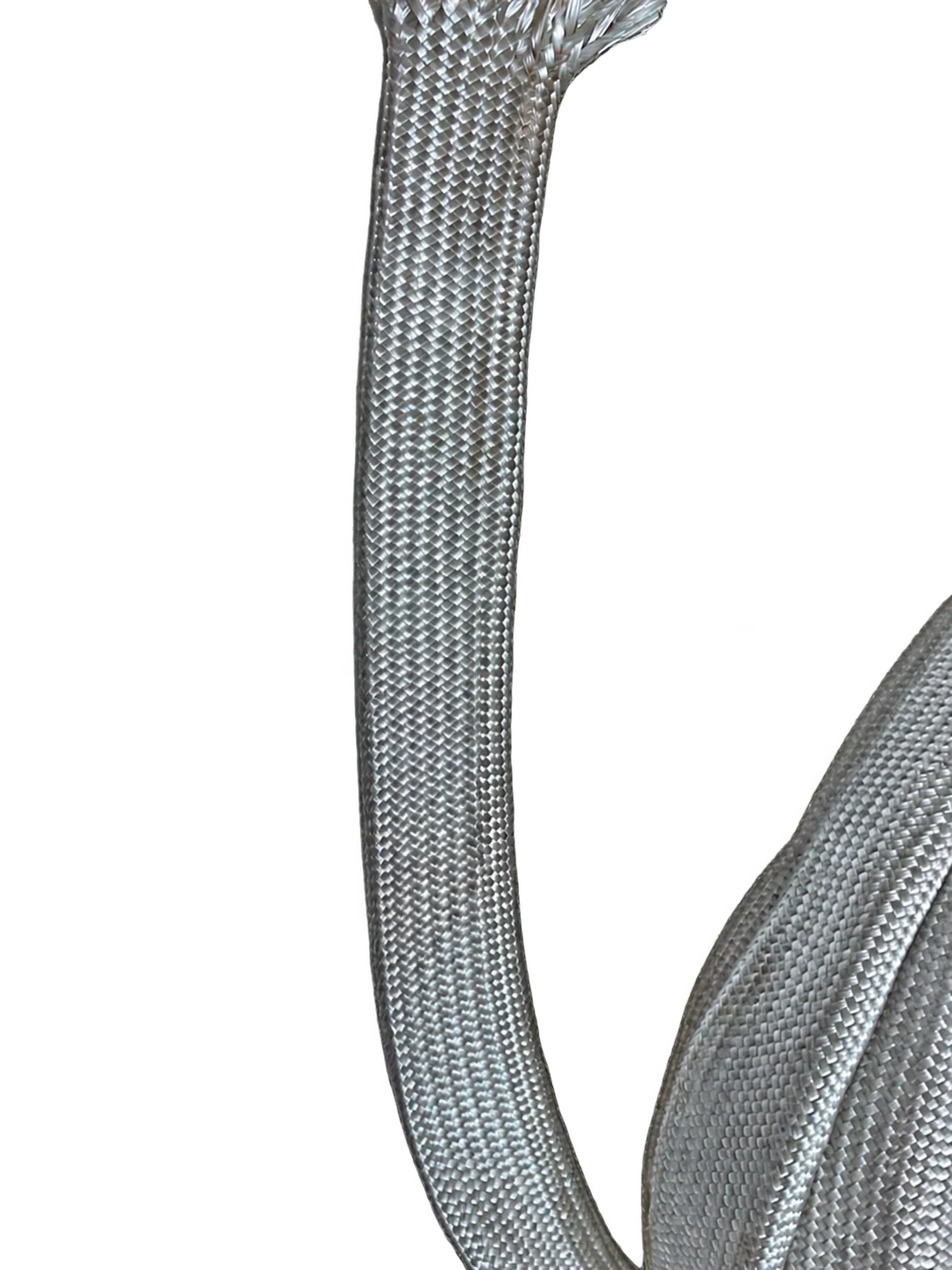
It doesn't stretch. The yarns in a braided sleeve run in two opposing helices, crossing over and under each other like a scissor lattice. When you push the sleeve together lengthwise, the braid angle opens up: the crossing points rotate, the sleeve gets shorter and wider, and the yarns themselves stay the same length. Pull it lengthwise and the angle closes, so the sleeve gets longer and narrower and grips the bundle.
That is why every catalogue expandable sleeve has an expansion range rather than a single diameter. For example, SYN-FBG-012 runs from 8 mm to 24 mm. It is also why an expanded sleeve is always shorter than it was on the spool.
What this means when you install fibreglass sleeving
1. Bend it, don't fold it
Route sleeved leads around smooth radii. Avoid sharp folds at cable-tie points, under P-clips, at panel edges and where a lead exits a terminal box. A crease is a tight radius, and a tight radius breaks filaments, just like a knot pulled tight.
2. Don't crush the spool or the coil
Store reels upright and avoid stacking heavy cartons on loose coils. Crushing creates the same small-radius kinks as folding. The damage often isn't visible until the sleeve is expanded and broken filaments start to shed.
3. Expect vibration to matter
Where filaments cross, they rub. Under constant vibration, that rubbing nicks the surface, and every nick is a new Griffith flaw. Moisture accelerates crack growth in glass under stress, a phenomenon called static fatigue or stress corrosion. On equipment with heavy vibration, clamp the sleeved bundle so it cannot flutter, and inspect at service intervals.
4. Cut cleanly and manage the ends
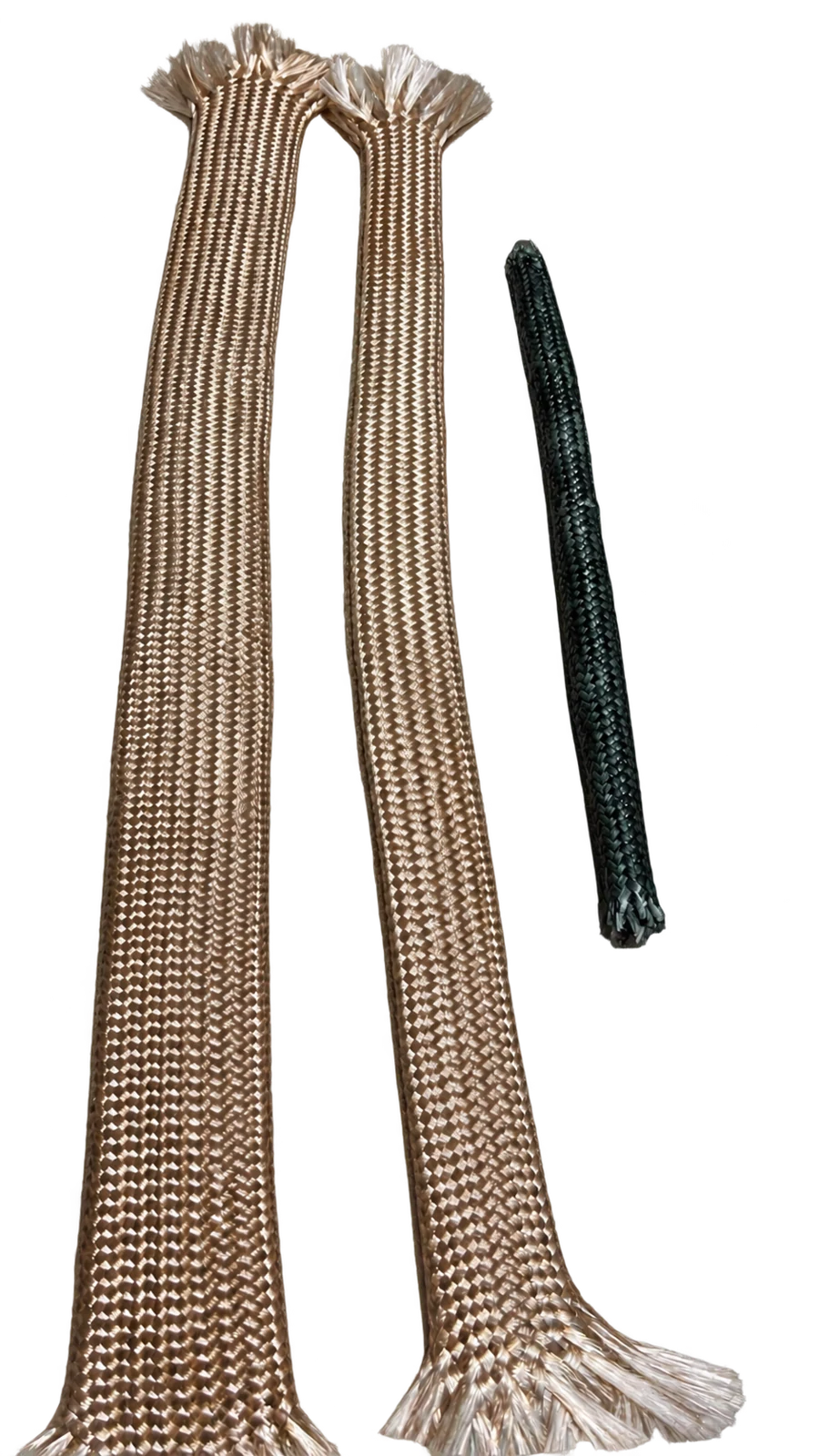
Unlike PET or nylon sleeving, glass will not melt and seal with a hot knife. Cut with sharp shears, then secure the ends with heat-shrink, a tape wrap or a ferrule so they don't fray. Heat-treated fibreglass frays noticeably less at cut ends, which is one reason it is chosen for short pieces.
5. Handle with gloves
Freshly cut ends shed short, stiff fragments that can irritate skin mechanically. That is the familiar fibreglass itch. Wear gloves and long sleeves when cutting, and clean the bench with a vacuum rather than compressed air. For context, continuous glass filament is classified by IARC as Group 3 (not classifiable as to carcinogenicity in humans). IARC also describes it as having diameters typically above 6 µm, coarser than the fibres generally considered respirable.
Choosing between fibreglass constructions
| Standard fibreglass SYN-FBG | Heat-treated fibreglass SYN-HT-FBG | |
|---|---|---|
| Feel and flexibility | Softer; size lubricates the filaments | Drier, firmer handle |
| Cut ends | Fray more readily | Heat-set; fray less |
| Tolerance of flexing and handling | Higher | Lower; route and support carefully |
| Hot-zone behaviour | Size burns off on first heating | Size already removed at the factory |
| Typical choice | General cable covering, motor and transformer leads, moderate heat | Heater leads, ovens, furnaces and clean-first-firing equipment |
Both are available in 14 catalogue sizes from 3 mm to 76 mm nominal, with 1,500-denier glass yarn as standard and custom constructions on request. The minimum order is 500 m.
Frequently asked questions
Why is fibreglass flexible if glass is brittle?
Brittle means a material cannot deform permanently before breaking. It does not mean it cannot bend. A thin glass filament needs very little surface strain to curve, because strain equals diameter divided by twice the bend radius, and it is far stronger than bulk glass because it carries fewer, smaller surface flaws.
How tightly can fibreglass sleeving be bent?
Individual filaments survive radii well under a millimetre, but a sleeve should always be routed around a smooth radius rather than folded. Folds, kinks and crushing break filaments locally even when the overall bend looks gentle.
Does expanding the sleeve stretch the glass?
No. Expansion comes from the braid angle opening, not from the yarn stretching. That is why the sleeve shortens as it widens.
Is fibreglass sleeving dangerous to handle?
Cut ends can cause temporary skin irritation, so wear gloves and long sleeves when cutting. Continuous glass filament is classified by IARC as Group 3, and its filaments are generally too coarse to be respirable.
The bottom line
Glass bends when it is thin because bending strain scales with thickness, and thin glass is far stronger because it carries smaller flaws. Split a rod into thousands of filaments that can slide, and stiffness falls by the same factor. Braid those filaments, and the sleeve can expand without stretching the glass at all. Install it with that physics in mind: curves, not creases; clamp out vibration; finish the cut ends; wear gloves.
References
- Griffith, A.A., The phenomena of rupture and flow in solids, Philosophical Transactions of the Royal Society A (1921).
- DuPont, Kevlar® Aramid Fiber Technical Guide (2017), Table II-2 (E-glass comparative yarn properties).
- ISO 2078, Textile glass: Yarns: Designation.
- IARC Monographs Volume 81, Man-made Vitreous Fibres (2002).
Where this shows up in the catalogue

Have a specification question?
Send your application details and we'll help match the right product and configuration.
Routing fibreglass sleeving on your equipment?
Send your bundle diameter, bend points and temperature through our technical enquiry form, or browse fibreglass expandable sleeving sizes.