
Grading Cable Damage Layer by Layer: When to Wrap, When to Joint, When to Replace
Every damaged cable raises the same question on the shop floor: can we wrap it and keep running? The answer depends on how deep the damage goes. Here is a five-grade system, layer by layer, and the two electrical checks that decide it.
A forklift clips a cable tray. A press guard drops on a floor run. A cable that has rubbed a frame for two years finally shows armour wire through its jacket. In every case the shift supervisor asks the same question: can we wrap it and keep running?
Sometimes the honest answer is yes, and a water-activated repair wrap puts the cable back into safe service in half an hour. Sometimes it is no, and wrapping the damage would only hide a fault that will trip the line, or worse, later. The difference is how deep the damage goes. This article gives you a five-grade system for deciding, layer by layer, and the two electrical checks that settle it.
For the broader question of repairing versus re-pulling a whole run, see our article on repair or replace. This one is about the damaged spot in front of you.
Know the layers
Most power cables in Indian plants are armoured low-voltage cables, PVC-insulated to IS 1554 or XLPE-insulated to IS 7098. From the outside in, they have the same layers, and each one has a job.
- Outer sheath: keeps out water, oil and dirt, and takes the scuffs.
- Armour: steel wires or strip that resist crushing and impact. On many installations the armour is also part of the protective earth path.
- Inner sheath or bedding: a cushion and a second barrier around the cores.
- Insulation: the layer that actually keeps each conductor's voltage where it belongs.
- Conductor: the copper or aluminium carrying the current.
Two checks before any repair
Visual inspection tells you how deep the damage looks. Two simple tests tell you how deep it is. Isolate and lock out the circuit following your plant's electrical safety procedure before either.
1. Insulation resistance
An insulation-resistance test (often called a megger test) applies a DC test voltage between conductors, and between conductors and earth, and measures the leakage. As a reference point, IEC 60364-6 sets a minimum of 1 MΩ for circuits up to 500 V, tested at 500 V DC. Many plants set higher acceptance values for their own cables, and the most useful comparison is with the cable's own commissioning or last maintenance reading. A sharp drop since the last reading says moisture or damage has reached the insulation, even if the cut looks shallow.
2. Armour continuity
On armoured cable, check continuity of the armour from gland to gland. If some armour wires have been cut, the earth path may now depend on the few that remain, or be broken altogether. A wrap will not restore that. It is an electrical problem and needs an electrical repair.
The five grades
| Grade | What you see | Insulation test | Action |
|---|---|---|---|
| 0 | Outer sheath scuffed or gouged, not through | Normal | Monitor. Wrap if the spot keeps getting hit. |
| 1 | Outer sheath cut or split, armour or bedding visible but intact | Normal | Wrap to seal and restore the outer shell. |
| 2 | Armour wires exposed and cut or corroded, or bedding breached | Normal | Restore armour continuity with an approved joint or bond, then wrap over it. |
| 3 | Core insulation nicked, crushed or exposed | Low or falling | Make a proper cable joint with an approved joint kit, then wrap over the joint for mechanical protection. |
| 4 | Conductor damaged or burnt; water inside; several damage points on an ageing run | Low | Replace the cable. |
Grade 0: scuffed, not through
The outer sheath is doing its job. No repair is needed, but a scuff is a warning. Something is rubbing or hitting the cable here, and it will be through next time. If the location gets regular traffic, a wrap over the spot adds a hard shell that takes the next knocks.
Grade 1: sheath cut, everything inside intact
This is the classic wrap repair. The cable is electrically sound, but its outer barrier is open. Left alone, coolant, oil and washdown water get in and work along the armour and bedding. Clean the area and wrap several overlapping layers, extending at least 50 mm beyond the damage on each side. The cured shell seals the cut and restores a hard outer layer, and the cable goes back into service once it has hardened, in about 30 minutes.
Grade 2: armour reached
Now the decision depends on the armour continuity check. If the armour is merely exposed, or a few wires are scratched, a wrap restores protection over it. If wires are cut through or badly corroded, the armour's strength and, more importantly, its role as an earth path are compromised. That must be restored first, with an approved armour bond or joint, by a qualified person. The wrap then goes on top as the mechanical shell.
Restoring the outer protection over armoured cable joints is one of the main jobs these wraps were developed for. The wrap is the last layer, not the first.
Grade 3: insulation damaged
Once the core insulation is nicked or crushed, the cable is no longer electrically sound, whatever it looks like. No wrap, tape or shell can restore insulation. The damaged section must be jointed with a proper cable joint kit rated for the cable's voltage and type, or the cable replaced. Where a joint is made, a repair wrap over the finished joint adds mechanical protection and impact resistance that most joint kits on their own do not have.
Grade 4: replace
Replace the cable when:
- the conductor is damaged, burnt or overheated;
- water has entered and travelled along the cable, which you will often see as a low insulation reading well away from the damage;
- the run has several damage points and is near the end of its life anyway;
- the insulation reading stays low after any repair.

Flexible, control and data cables
The same grading works for unarmoured cables, without the armour step. Two cautions apply:
- Flexible cables that move in service should not be wrapped in a rigid shell at all, whatever the grade. See our guide to where a rigid wrap belongs in robot cells.
- Screened data and fieldbus cables rely on an unbroken screen for noise immunity. If the screen is cut, the cable needs a proper repair or replacement, even when the cores test well.
Write the decision down
The best plants turn this grading into a one-page procedure at each maintenance desk: the grade, the tests, the action, who may carry it out, and a log of every repair with its location. That log is what turns repeated repairs into a fixed root cause, such as a floor run that needs re-routing into conduit or a guard edge that needs protecting.

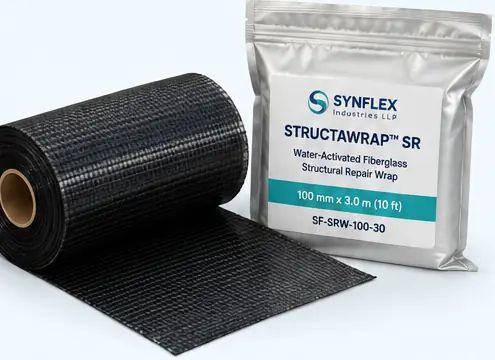
Grades 0 to 2, caught early, are where a STRUCTAWRAP SR repair saves the most: a half-hour job instead of a cable pull. Grades 3 and 4 are where knowing its limits matters most.

Have a specification question?
Send your application details and we'll help match the right product and configuration.
Building a cable repair procedure for your plant?
Tell us the cable types you run and the damage you see most often through our technical enquiry form, and we will suggest where a wrap fits in your procedure. See STRUCTAWRAP SR roll sizes.