
5,000 Flex Cycles at −40 °C and +150 °C: How We Test PA-6 Conduit for Moving Machinery
A conduit on a moving machine bends thousands of times a day. In the cold it can crack, and in the heat it can sag and set. We put PA-6 Heavy Weight FR conduit through 5,000 cycles at each extreme. Here is how the test works and what it tells you.
Most conduit is installed once and left alone. Conduit on a robot arm, a machine door, a folding guard or a vehicle body is different. It bends every time the machine moves, thousands of times a day, often in a cold store, a foundry, an engine bay or an outdoor cabinet.
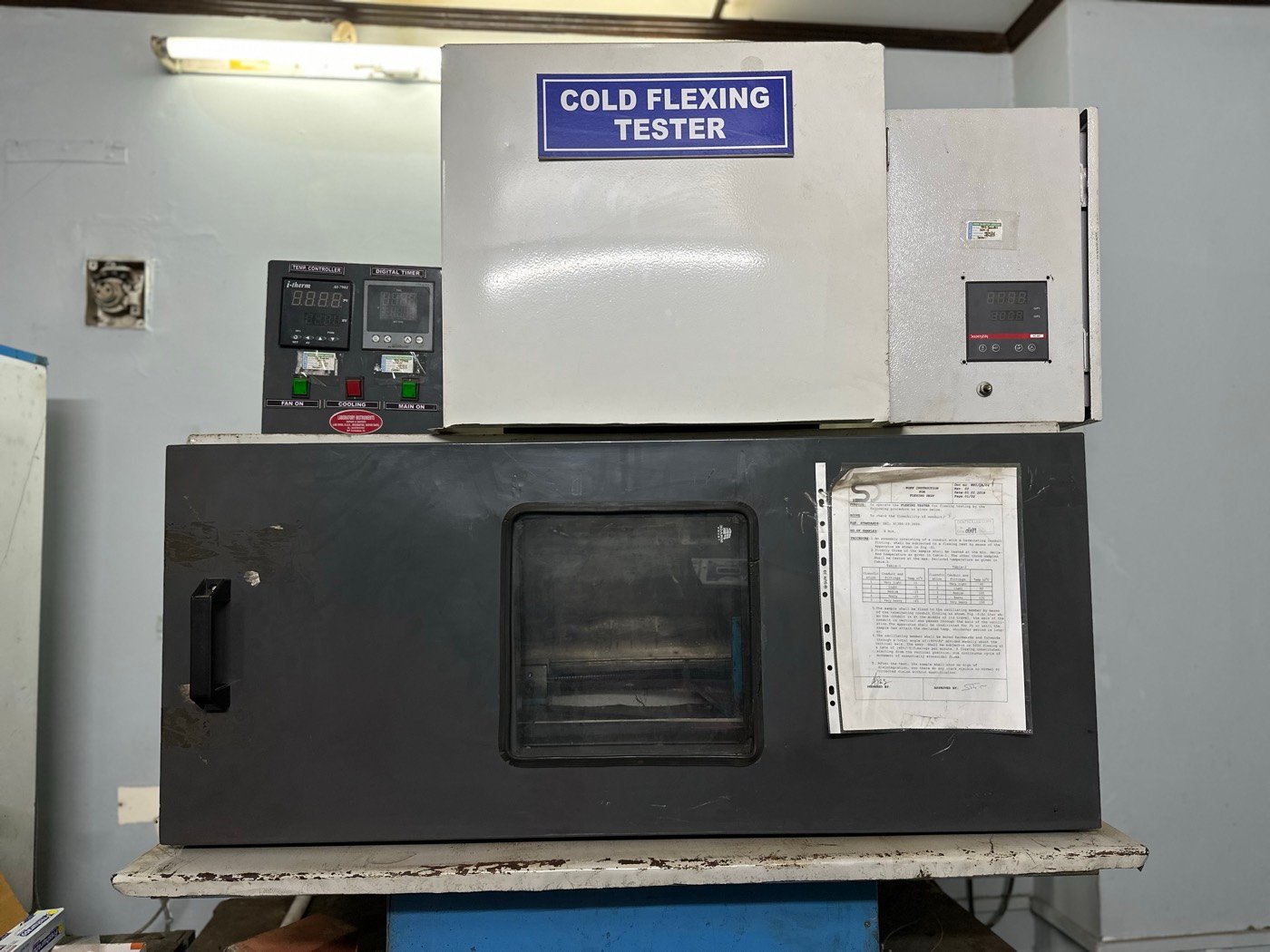
Static tests such as compression and impact say little about that life. What matters is whether the conduit survives repeated bending at the temperature it will actually see. So we test it that way. In the Synflex test lab, PA-6 Heavy Weight FR conduit completed 5,000 flexing cycles at −40 °C and 5,000 cycles at +150 °C. This article explains how the tests work, what failure looks like, and how to use the results.
How a flexing test works
The test rig is simple to describe and slow to run. A length of conduit is clamped at one end. The other end is fixed to an arm driven by a crank, which swings it through a set arc. Each swing bends the conduit one way and then back. The whole rig sits inside a temperature chamber, so the conduit is flexed at the temperature under test, not just stored at it.
- Condition. The sample is brought to the test temperature and held there, so the whole wall, not just the surface, reaches it.
- Flex. The arm runs for the set number of cycles, here 5,000, while the chamber holds temperature.
- Inspect. The sample is examined for cracks, splits and whitening at the corrugation crests, for permanent kinks or flattening, and for any change in the bore.
We run it at two extremes, because conduit fails in two quite different ways.
Cold flexing at −40 °C: the cracking test
Every plastic has a glass transition temperature. Above it, the polymer chains have room to move and the material is tough. Below it, they are frozen in place and the material is stiff. For polyamide 6 the glass transition sits roughly between 0 and 60 °C, depending on how much moisture it has absorbed. At −40 °C, PA-6 is far below it.
Bending a corrugated conduit does not stretch it evenly. The strain gathers at the crests and roots of the corrugations on the outside of the bend. In a material that cannot relax at low temperature, that is where cracks start: first as fine whitened lines, then as splits through the wall. Once a crack opens, dust, coolant and water follow it in.

A conduit that completes 5,000 cycles at −40 °C has shown that its grade and wall design spread that strain without cracking. That links to the cold ratings on the datasheet. PA-6 Heavy Weight FR is listed at a lower temperature of −40 °C (Class 4 under IEC 61386) and an impact strength above 6 J at −15 °C. A flexing test adds what those single events cannot: fatigue, the slow damage of the same bend repeated thousands of times.
Hot flexing at +150 °C: the softening test
Heat causes the opposite problem. Well above its glass transition, PA-6 becomes softer and more pliable. That makes it easier to bend, but it also makes it creep. Under repeated bending at high temperature, a weak conduit takes a permanent set: it stays bent, the corrugations flatten on the inside of the curve, the bore ovalises, and it may kink. Polyamide 6 melts at about 220 °C, so at +150 °C the material is well on its way to soft.
For PA-6 Heavy Weight FR, +150 °C is the short-term limit on the datasheet. Its continuous working range is −40 to +105 °C, with an upper class temperature of +120 °C under IEC 61386. Flexing it 5,000 times at its short-term ceiling tests the margin above the working range, the situation it meets near a hot exhaust, a heater or a sun-baked enclosure on a summer afternoon.
| Cold flexing | Hot flexing | |
|---|---|---|
| Chamber temperature | −40 °C | +150 °C |
| Cycles completed | 5,000 | 5,000 |
| State of PA-6 | Far below glass transition: stiff | Far above glass transition: soft |
| What fails in a weak conduit | Cracks and splits at corrugation crests | Permanent set, flattened corrugations, ovalised bore, kinks |
| Datasheet link | Lower temperature −40 °C, Class 4 | Short-term +150 °C; continuous up to +105 °C |
Why 5,000 cycles?
Five thousand cycles is a test, not a lifetime. A machine door opened 50 times a day reaches it in about three months; a robot dress pack can reach it in a single shift. The test is a comparative screen: it separates grades and designs that crack or set early from those that do not, at the temperatures where problems start. Real life also depends on how tightly the conduit bends, which you control at the design stage.
Bend radius: the setting that matters most
Strain at the corrugation crests rises sharply as the bend radius gets smaller. A conduit that survives indefinitely at a generous radius can crack in days if it is forced round a tight corner every cycle. Keep moving sections at or above the minimum bend radius, and preferably well above it:
| Size | ID (mm) | OD (mm) | Minimum bend radius |
|---|---|---|---|
| NW-10 | 9.5 | 13.0 | 20 mm |
| NW-12 | 11.2 | 15.8 | 35 mm |
| NW-17 | 15.8 | 21.2 | 45 mm |
| NW-23 | 22.5 | 28.5 | 55 mm |
| NW-29 | 27.5 | 31.4 | 65 mm |
| NW-36 | 35.5 | 42.4 | 75 mm |
| NW-48 | 47.0 | 51.4 | 90 mm |
| NW-70 | 67.5 | 80.0 | 105 mm |
PA-6 Heavy Weight FR conduit, from the product datasheet. Minimum radii are for installation; for continuous flexing, allow more.
Designing a moving conduit run

- Give the bend room. Spread the movement over a long loop rather than a short hinge. The longer the moving length, the smaller the bend each section sees.
- Anchor both sides of the motion. Clamp the conduit firmly on each side of the joint so the bending happens in the loop, not at the fittings. A fitting is a stiff point, and repeated bending right at its mouth concentrates strain there.
- Avoid twisting. Corrugated conduit handles bending well and torsion poorly. Where a joint rotates, route the conduit so rotation becomes bending, or use a swivel fitting.
- Watch the temperature at the conduit, not the room. A run beside an exhaust or heater can sit far above ambient. Measure it if in doubt. For hot zones beyond the conduit's range, a sleeve such as heat-treated fibreglass over the hottest section may be the answer.
- Install warm, flex cold. If the equipment works in the cold, install and form the conduit at normal temperature. Bending conduit sharply while it is frozen is the most likely moment to crack it.
What to ask a conduit supplier
- Has the conduit been flex-tested, and at what temperatures?
- How many cycles, at what bend radius and arc?
- What was inspected afterwards: cracks only, or also set, ovality and bore?
- Does the continuous temperature range on the datasheet cover your hottest and coldest point, with margin?
For the other half of mechanical performance, a straight pull along the run, see our tensile strength test, where the same conduit let go at 500 N.


Have a specification question?
Send your application details and we'll help match the right product and configuration.
Routing conduit on moving or outdoor equipment?
Tell us the motion, the bend radius and the temperature range through our technical enquiry form, and we will suggest a conduit size and grade. See PA-6 Heavy Weight FR conduit sizes and bend radii.