
Why Aramid Doesn't Melt: The Molecular Story Behind Para-Aramid Sleeving in Defence and Aerospace Wiring
Polyester and nylon sleeves melt and drip at about 255 °C. Aramid holds its shape until it decomposes above 425 °C. The reason sits in the shape of the molecule, and so do its limits.
Put a polyester or nylon braided sleeve in a fire, or next to a hot short, and somewhere around 255 °C it melts. The molten polymer flows, drips and sticks to whatever is below it, often the very conductors it was supposed to protect. Put an aramid sleeve in the same place and nothing flows. It holds its shape, darkens and only starts to break down somewhere above 425 °C, as a char rather than a liquid.
That one behaviour, decomposing instead of melting, is a large part of why aramid shows up in military vehicles, aircraft and missile harnesses. This article explains where it comes from at the molecular level, what it means in a real wiring loom, and the limits that a "doesn't melt" headline tends to hide.
What melting actually is, for a polymer
Polyester (PET) and nylon are long, flexible chain molecules. At room temperature they are tangled and partly crystalline, held together by relatively weak forces between neighbouring chains. Heat them, and at their melting point those inter-chain forces give way: the chains start to slide past each other and the solid becomes a viscous liquid. The chemical bonds along each chain are still intact. Melting only means the chains have become free to move.
This is useful in manufacturing, because PET and nylon yarns are made by melting the polymer and pushing it through a spinneret. In a fire it becomes a liability: the same mobility that makes them easy to spin makes them flow and drip.
Why the aramid molecule cannot do that
Para-aramid, the polymer sold under trade names such as Kevlar®, is poly-para-phenylene terephthalamide (PPTA). Two features of its structure decide its behaviour:
- Rigid rods instead of flexible chains. The backbone is a string of benzene rings joined by amide links at opposite (para) positions. Each repeat unit is flat and straight, so the whole molecule behaves like a stiff rod rather than a strand of spaghetti.
- Hydrogen-bonded sheets. The amide groups on neighbouring rods form hydrogen bonds with each other (N–H···O=C), locking the rods side by side into flat sheets. DuPont's technical guide describes the fibre as these sheets stacked radially around the fibre axis.
To melt, those rods would have to break free of their neighbours and slide. The combination of stiffness, tight packing and dense hydrogen bonding means the energy needed to do that is higher than the energy needed to break the chemical bonds along the chain itself. So the polymer never reaches a melting point. As temperature rises, it decomposes first.
The same structure is why it is so strong
Rigid rods do not tangle. In concentrated solution they line up spontaneously into ordered domains: a liquid crystal. Since PPTA cannot be melted, it is dissolved in concentrated sulfuric acid and spun from that liquid-crystalline solution. As the solution is forced through the spinneret, the domains align almost perfectly along the fibre axis. Nylon and polyester only approach that orientation by being drawn after spinning, and never fully reach it. Aramid gets there in the spinning step itself. That near-perfect alignment is the source of its strength.
The numbers behind the behaviour
DuPont's technical guide compares its reference aramid yarn against other common fibres. The figures below come from that table:
| Fibre | Density (g/cm³) | Tensile strength (MPa) | Strength per unit weight, relative to steel wire | What happens when heated |
|---|---|---|---|---|
| Para-aramid (Kevlar® 29) | 1.44 | 2,920 | ≈ 8× | Decomposes at 427–482 °C in air; does not melt |
| E-glass | 2.55 | ≈ 3,450 | ≈ 5× | Inorganic; softens far above aramid's limit |
| Steel wire | 7.75 | ≈ 1,970 | 1× (reference) | Melts ≈ 1,500 °C |
| Polyester (PET) | 1.38 | ≈ 1,160 | ≈ 3× | Melts ≈ 256 °C |
| Nylon 66 | 1.16 | ≈ 990 | ≈ 3× | Melts ≈ 254 °C |
Yarn values from DuPont's Kevlar® Aramid Fiber Technical Guide, Table II-2, converted to SI units. They are typical values for DuPont's Kevlar® 29 reference yarn; other producers' para-aramid yarns have similar but not identical properties. Typical properties, not specifications. A braided sleeve's performance also depends on its construction.
What "doesn't melt" means inside a wiring loom
1. No melt-drip
Molten polymer is one of the main ways a small fire spreads along a cable run. DuPont's vertical flame tests on aramid fabrics report no drips, with burning stopping once the flame is removed. Aramid's limiting oxygen index is 29, meaning it needs an atmosphere of about 29 % oxygen to keep burning. Ordinary air is about 21 %.

2. It does not shrink back and expose the wire
Many thermoplastic sleeves shrink permanently after repeated heat cycles, pulling back from terminations and leaving bare spots. DuPont lists aramid shrinkage at below 0.1 % in dry air at 177 °C and in boiling water. Its lengthwise thermal expansion is actually very slightly negative.
3. It stays tough in the cold
DuPont's arctic test data show aramid yarn at −46 °C slightly stronger than at room temperature, and the guide reports essentially no embrittlement down to −196 °C. That matters for high-altitude aircraft, for equipment deployed in the Himalayan sectors, and for anything that will be flexed in the cold.
4. It is light for its strength
By weight, para-aramid yarn is roughly eight times stronger than steel wire and about 1.5 times stronger than E-glass. In an aircraft or a soldier-portable system, every gram of protective sleeving is a gram of payload or fuel given up.
5. It resists cut-through
Sharp airframe brackets, sheet-metal edges in vehicle hulls and fasteners in tight equipment bays are classic chafe points. High-strength, high-modulus filaments spread the load of an edge across many fibres instead of letting it slice through a few. That is why aramid is chosen where cut and abrasion, not heat, are the main threats.
What "doesn't melt" does not mean
This is where many datasheets and sales pages oversimplify. Aramid has real limits, and anyone specifying it for defence or aerospace work needs to know them.
It is not fireproof, and not a high-temperature sleeve
Decomposition at 427–482 °C is a breakdown point, not a working temperature. DuPont's recommended range for long-term use in air is 149–177 °C. Its own strength-retention curves show aramid yarn holding up well for hundreds of hours at 160 °C, but losing more than half its strength in under 100 hours at 250 °C. For continuous duty above about 180 °C, fibreglass or heat-treated fibreglass sleeving is the better choice.
It still gives off smoke and gases when it burns
In DuPont's oxygen-starved combustion tests, aramid released less carbon monoxide and hydrogen cyanide per gram than nylon 66 (50 vs 250 mg/g CO; 14 vs 30 mg/g HCN), but not zero. For crew compartments, aircraft cabins and enclosed shelters, smoke and toxicity requirements have to be met by the complete harness design, not assumed from the fibre.
Sunlight degrades it
Aramid absorbs light in the 300–450 nm range (near-UV and violet), and prolonged exposure turns it from yellow to brown and costs it strength. In DuPont's xenon-arc tests, a 1,500-denier yarn kept only about a third of its strength after 450 hours. Topside, outdoor or uncovered runs need a UV-blocking overlayer or a different material. We cover this in detail in aramid's honest weaknesses.
Some chemicals attack it, including bleach
Aramid shrugs off jet fuel, kerosene, mineral oil and common solvents in DuPont's chemical-resistance tables. Strong acids, strong alkalis and sodium hypochlorite are a different story: a 0.1 % hypochlorite solution severely degraded the yarn over 1,000 hours. That is worth knowing for equipment that is routinely washed down with chlorine-based cleaners.
Where it fits in defence and aerospace wiring
- Armoured and soft-skin military vehicles: harnesses through hull penetrations, engine and transmission bays, and turret slip-ring areas, where vibration, sharp sheet-metal edges and fuel exposure combine.
- Helicopter and fixed-wing harnesses: abrasion protection at bulkheads, brackets and moving surfaces where weight is tightly budgeted.
- Missile and ordnance harnesses: cables pulled through tight bays during assembly, where cut-through by structure is a real risk.
- Radar, communication shelters and ground-support equipment: cables that are repeatedly connected, dragged and re-routed in the field.
- Naval systems below deck: DuPont reports no strength loss after a year in sea water. Topside runs still need UV protection.
Across DRDO laboratories, HAL, the defence PSUs and their growing private-sector supply chain, indigenisation is pushing more of these materials toward domestic sources. For harness makers that means one practical question: can the sleeving supplier provide consistent yarn, controlled construction and the documentation a defence quality plan expects?
Synflex aramid sleeving: what it is, and what it isn't
- Yarn: standard 1,670 dtex / 1,000-filament aramid (≈ 1,500 denier). Depending on the order, Synflex braids with DuPont Kevlar® or another producer's para-aramid. The count matches the Kevlar® 29 reference yarn in DuPont's technical guide, which is why that guide's published data are used above as a reference for typical para-aramid behaviour. The yarn producer and grade are stated on each quotation, and custom deniers are available.
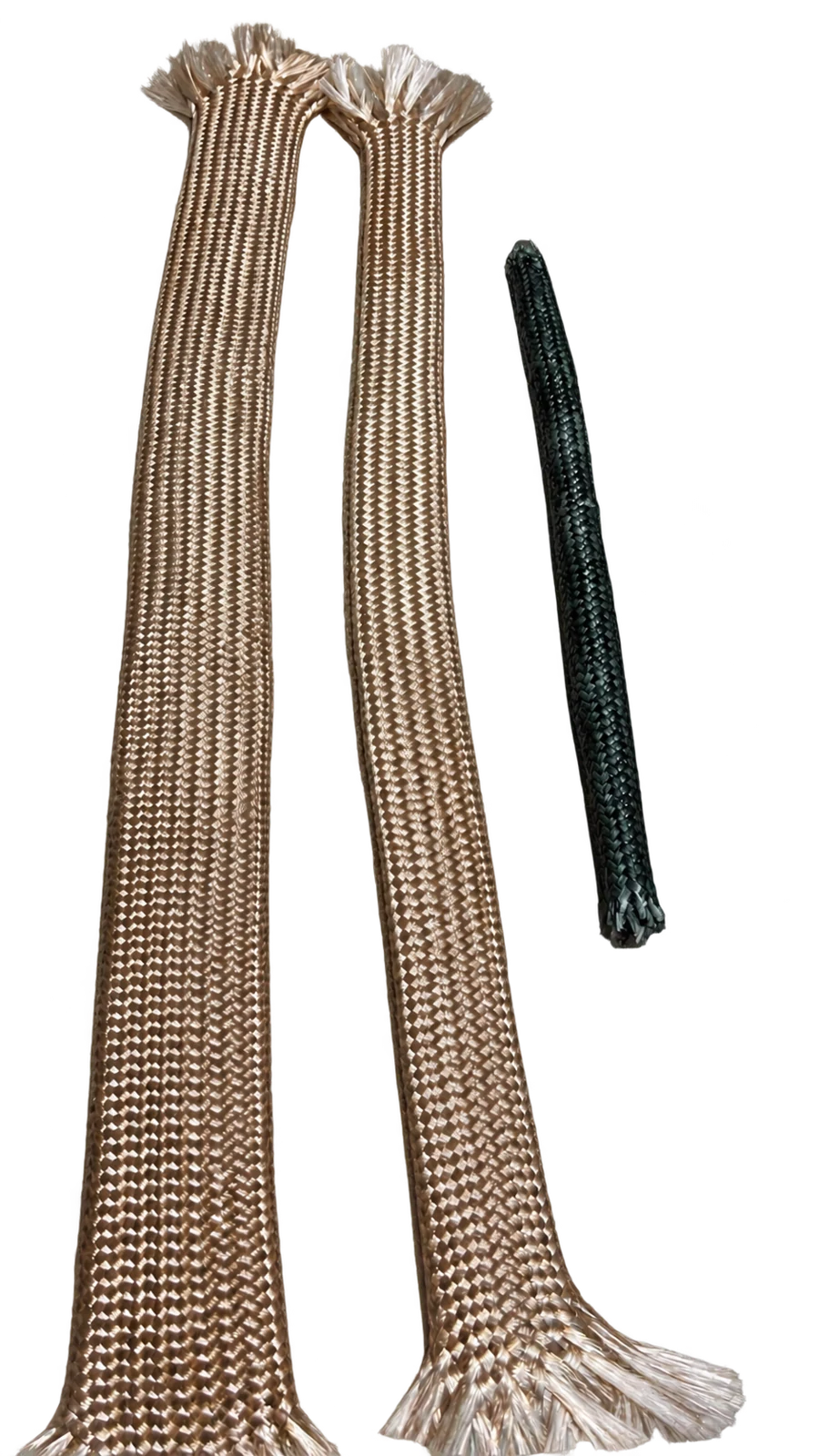
- Construction: expandable tubular braid, natural yellow, made in-house in Faridabad.
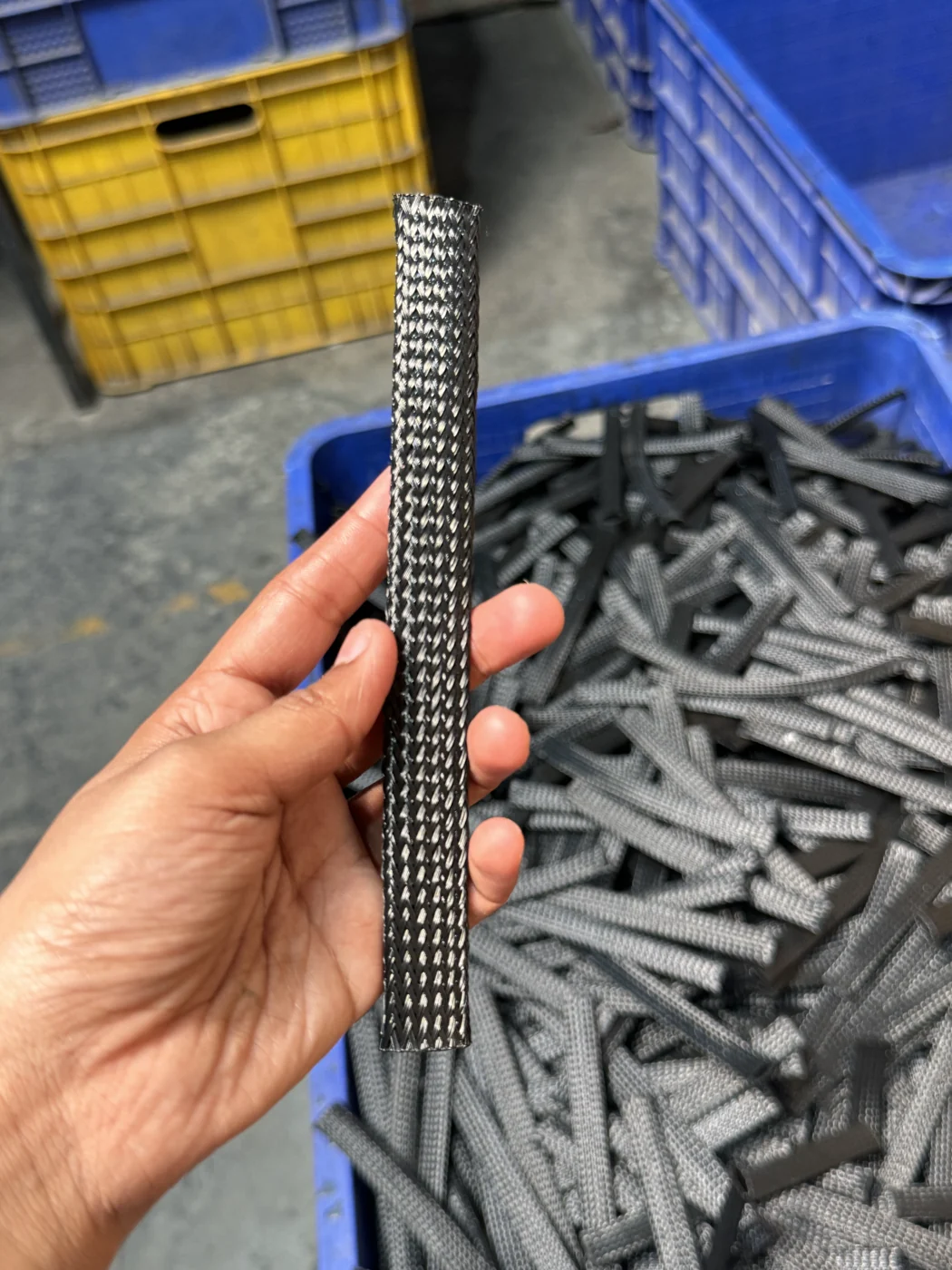
- Sizes: 14 catalogue references from SYN-KEV-003 (expands 1–6 mm) to SYN-KEV-076 (64–120 mm), plus customised expansion ranges.
- Documents: manufacturer RoHS and REACH declarations, material certificates and internal test reports on request. Company ISO 9001:2015 certification.
- Ordering: minimum order 500 m; customised constructions in 1–2 months.
One honest note: yarn data such as the figures in the table above describe the fibre, not a finished sleeve. Cut resistance, abrasion life and flame behaviour of a braided sleeve depend on braid angle, coverage and wall build. If your programme needs a qualified value, ask for sleeve-level test data against your specification.
What to tell us when you enquire
- The dominant threat: cut, abrasion, heat or a combination.
- Continuous and peak temperature at the sleeve.
- Fluids it will see: fuel, hydraulic oil, coolant, cleaning agents.
- Whether the run is exposed to daylight or is enclosed.
- Bundle diameter and the largest connector it must pass over.
- The documentation your quality plan or customer requires.
Frequently asked questions
Does aramid melt?
No. Para-aramid has no melting point. It decomposes at about 427–482 °C in air, depending on how fast it is heated, because its rigid, hydrogen-bonded chains cannot slide apart before the chain bonds themselves break.
Is aramid sleeving fireproof?
No. It is inherently flame-resistant, self-extinguishes in normal air and does not drip, but it can be ignited and will decompose. For long-term use, keep it within about 149–177 °C.
Is aramid sleeving better than fibreglass sleeving?
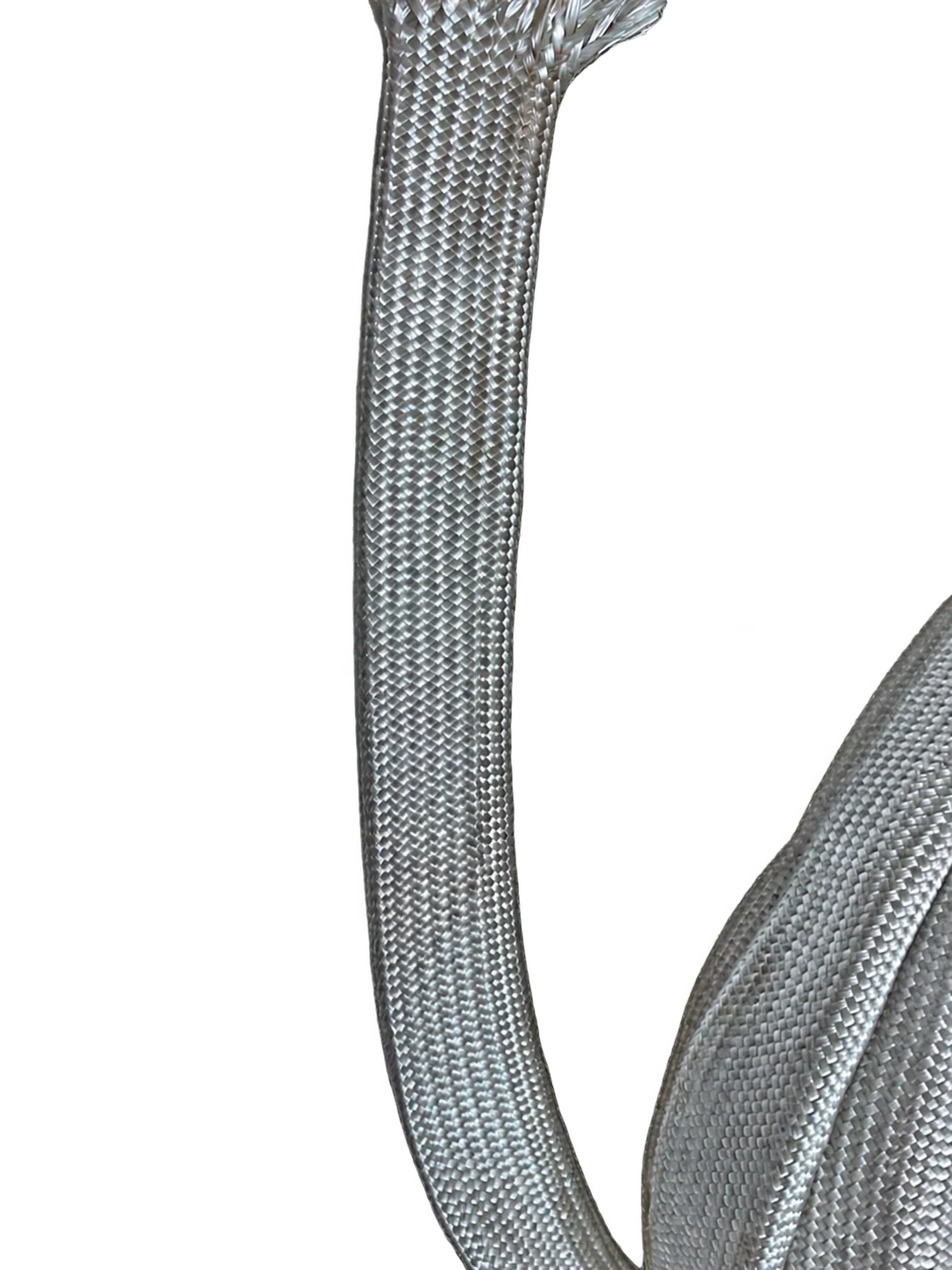
It depends on the threat. Aramid is lighter and better against cut and abrasion. Fibreglass handles far higher continuous temperatures and is unaffected by UV. Many harnesses use both, glass in the hot zone and aramid along the abrasion-prone run.
Why is aramid sleeving yellow?
Natural para-aramid yarn is pale yellow. Over time, light exposure darkens it toward brown. Slight darkening under room light is normal and not a sign of damage, but strong browning outdoors indicates UV degradation.
The bottom line
Aramid does not melt because its rigid, hydrogen-bonded molecules cannot slide apart before they decompose. The same alignment gives it roughly eight times the strength of steel wire by weight. In defence and aerospace wiring, that means no melt-drip, no shrink-back, good cold toughness and strong cut resistance at low weight. Its limits are real, though: a long-term ceiling around 150–180 °C, UV sensitivity, and vulnerability to strong acids, alkalis and bleach. Specify it for what it does best, and protect it from what it doesn't.
References
- DuPont, Kevlar® Aramid Fiber Technical Guide (2017): Tables II-1, II-2, II-3, II-6, II-7, II-8; Figures 2.7 and 2.12.
- Open-access review of para-aramid (PPTA) structure and processing, PubMed Central PMC9325195.
Kevlar® and Nomex® are registered trademarks of DuPont de Nemours, Inc. or its affiliates. Fibre property values are typical published values and are not product specifications.
Where this shows up in the catalogue

Have a specification question?
Send your application details and we'll help match the right product and configuration.
Specifying sleeving for a defence or aerospace harness?
Send the threat (cut, abrasion or heat), temperature, fluids and documentation requirements through our technical enquiry form, or view aramid expandable sleeving sizes.