
Inside the Braiding Machine: How Expandable Fibreglass Sleeving Is Made
Every metre of expandable fibreglass sleeving starts as kilometres of glass yarn on a cone. Here is how a braiding machine turns it into a tube, and why the braid can expand at all.
Every metre of expandable fibreglass sleeving starts as a few kilometres of glass yarn on a cone. A braiding machine turns it into a tube. It does that with a mechanism that is more than a century old and still fascinating to watch: bobbins that chase each other round a track in two directions, weaving over and under as they pass.
This article takes you inside the Synflex braiding floor in Faridabad. It explains how a braiding machine works, why braided sleeving can expand at all, why glass yarn needs particular care on the machine, what changes when a sleeve is heat-treated, and what we check before a spool leaves the factory. If you specify or buy sleeving, knowing how it is made helps you understand the numbers on the data sheet.
Step 1: from cone to carrier bobbin
Glass yarn arrives from the yarn producer on large cones. The braiding machine cannot use these directly. It carries the yarn on small bobbins, one per carrier, so the first job is bobbin winding: rewinding yarn from the cones onto carrier bobbins.
This step matters more than it looks. Each bobbin must be wound to an even tension and a similar length. A bobbin wound too tight or too loose feeds yarn differently from its neighbours, which shows as an uneven braid. And a bobbin that runs out early stops the whole machine. For our standard white sleeving, SYN-FBG, the yarn is 1,500 denier E-glass.
Step 2: the maypole dance
A tubular braiding machine is often called a maypole braider, after the dance where ribbons are woven round a pole. The carriers sit on a circular track driven by a ring of toothed horn gears. Half the carriers travel clockwise, half anticlockwise. Each one follows a wavy path, passing alternately inside and outside the carriers coming the other way.
All the yarns converge at the centre, at the braiding point, where the tube forms. A take-up mechanism draws the finished braid away at a steady speed. Two settings define the result:
- Number of carriers. More carriers means more yarns around the circumference, which gives better coverage at a given diameter. Sleeving machines commonly have 16, 24, 32 or 48 carriers.
- Take-up speed relative to carrier speed. This sets how tightly the yarns are laid, measured as picks (crossings) per unit length, and therefore the braid angle. A slower take-up packs the yarns more closely and gives a steeper angle and denser braid.
Why braided sleeving can expand
This is the part most buyers have never had explained. A braided sleeve expands because its yarns don't stretch; they change angle, like a garden trellis or a scissor lift.
Follow one yarn around the sleeve. Over one complete turn, it travels a fixed length along a helix. If the braid angle to the axis is θ, that fixed yarn length s splits into a circumferential part and a lengthwise part:
- Diameter: D = s · sin θ / π
- Length of one turn: p = s · cos θ
Push the sleeve together and θ increases: it gets wider and shorter. Pull it and θ decreases: it gets narrower and longer. Take a sleeve whose braid angle goes from 30° to 60° as it is pushed over a bundle:
- The diameter increases by sin 60° / sin 30° = 1.73 times.
- The length shrinks to cos 60° / cos 30° = 0.58 times, more than 40 % shorter.
That second number explains the practical advice in our sizing guide. A sleeve forced near the top of its range is not just tight; it is also much shorter than the length that was cut, and its yarns are packed close to their limit. Expansion stops where the yarns jam side by side, and contraction stops where they jam lengthwise. Those two jamming points define the expansion range on the data sheet: for example, 3–9 mm for size 006.
Why glass is harder to braid than polyester
The same machine design braids PET, nylon, aramid and glass, but glass demands more care at almost every point:
- Abrasion. Glass is hard enough to cut grooves in ordinary steel guides over time. Yarn guides and eyelets in the yarn path need to be ceramic or highly polished, and checked for wear. A worn guide damages every metre of yarn that passes it.
- Bending. Each glass filament is only a few micrometres across. That is what lets it bend at all, as we explained in glass you can tie in a knot. But a tight radius at a guide or a snag still breaks filaments. Broken filaments show up as "fuzz" on the sleeve surface, and an experienced operator watches for it.
- Tension. Glass has very little stretch, so it cannot absorb uneven tension the way polyester can. Carrier tension springs need to be well matched.
- No heat sealing. Polyester sleeve can be cut and sealed with a hot knife. Glass cannot, so cut ends are finished in other ways on the line.
- Dust. Braiding and cutting glass yarn release short fragments, so the floor needs good housekeeping and extraction, and operators wear appropriate protection. Continuous filament glass is classed by IARC in Group 3 (not classifiable as to carcinogenicity to humans), but the fragments are still a skin and respiratory irritant.
Every machine has a stop motion: a sensor on each carrier that stops the machine immediately if a yarn breaks or a bobbin runs out. A missing yarn would leave a weak, uneven line along the sleeve, so the machine stops rather than continuing.
Step 3: heat treatment, for SYN-HT-FBG
Standard glass yarn carries a textile size, a starch-oil coating typically 0.5–3 % by weight, that protects it during winding and braiding. For heat-treated sleeving, the braided sleeve then goes through a controlled heat-cleaning process that burns off that coating. Heat cleaning of glass textiles is typically done in the range of about 540–680 °C, and reduces the organic content to a fraction of a percent.
Two things are visible when it comes out:
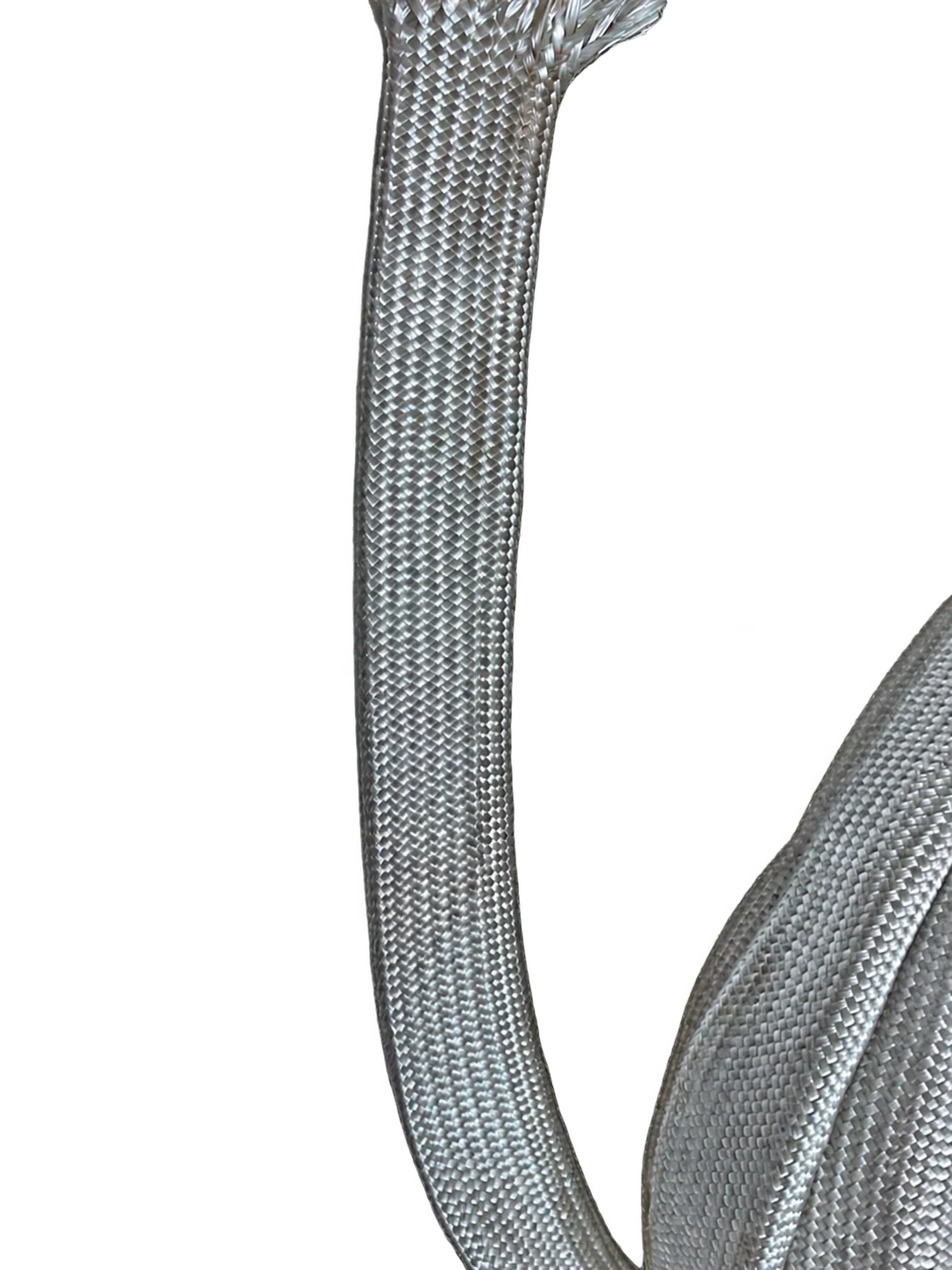
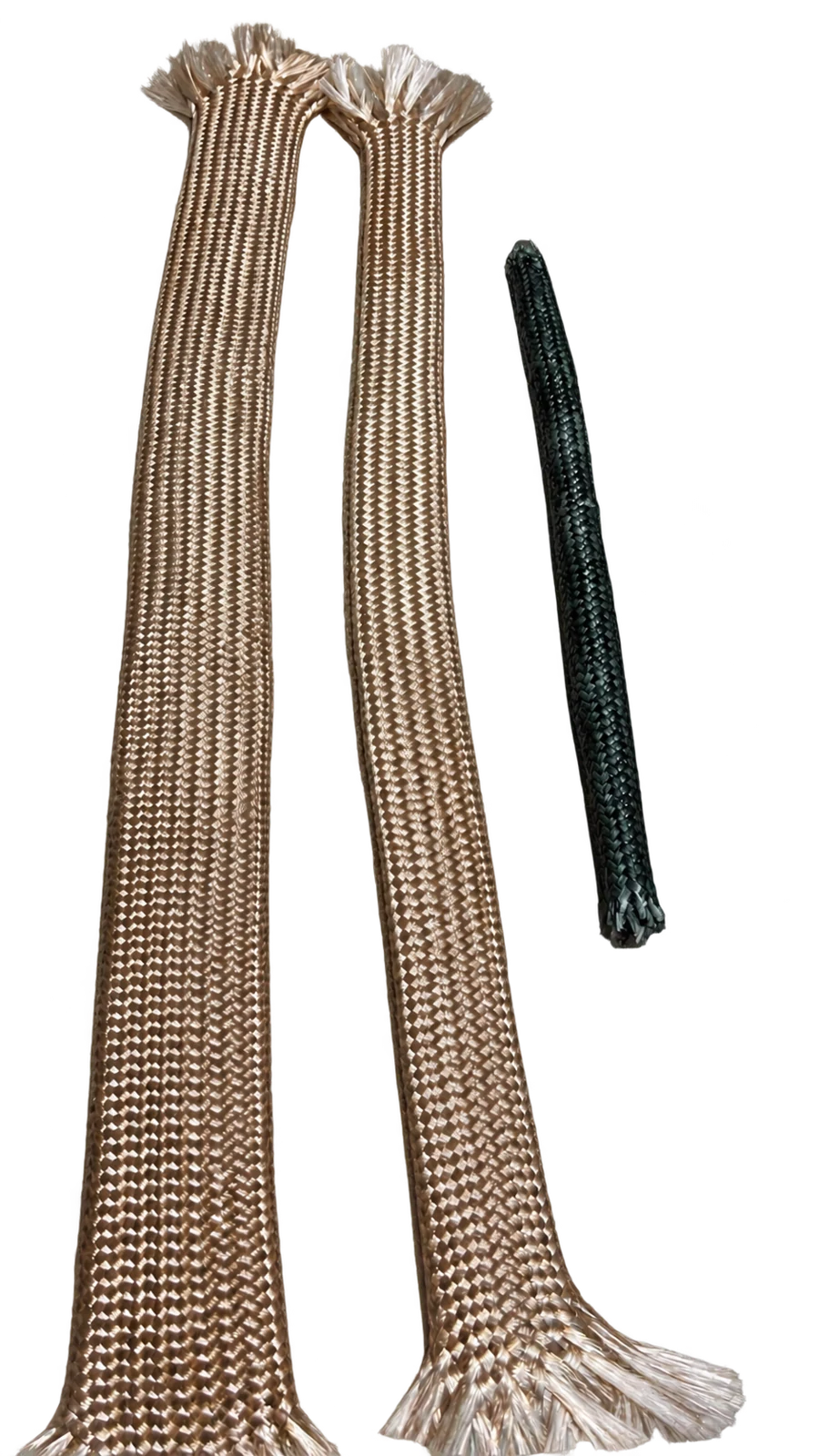
- The colour changes from white to a bronze or golden tone. That is the characteristic look of SYN-HT-FBG.
- The handle changes. Without the size, the sleeve feels drier and slightly less supple.
The process needs careful control. Glass loses strength when it is heated: published research shows E-glass fibres retaining only about a third of their room-temperature strength after exposure to 450 °C. The aim is to remove the size completely, with as little time at temperature as possible. Why this matters to heater makers is the subject of our article on why new heaters smoke.
Step 4: checks before a spool leaves
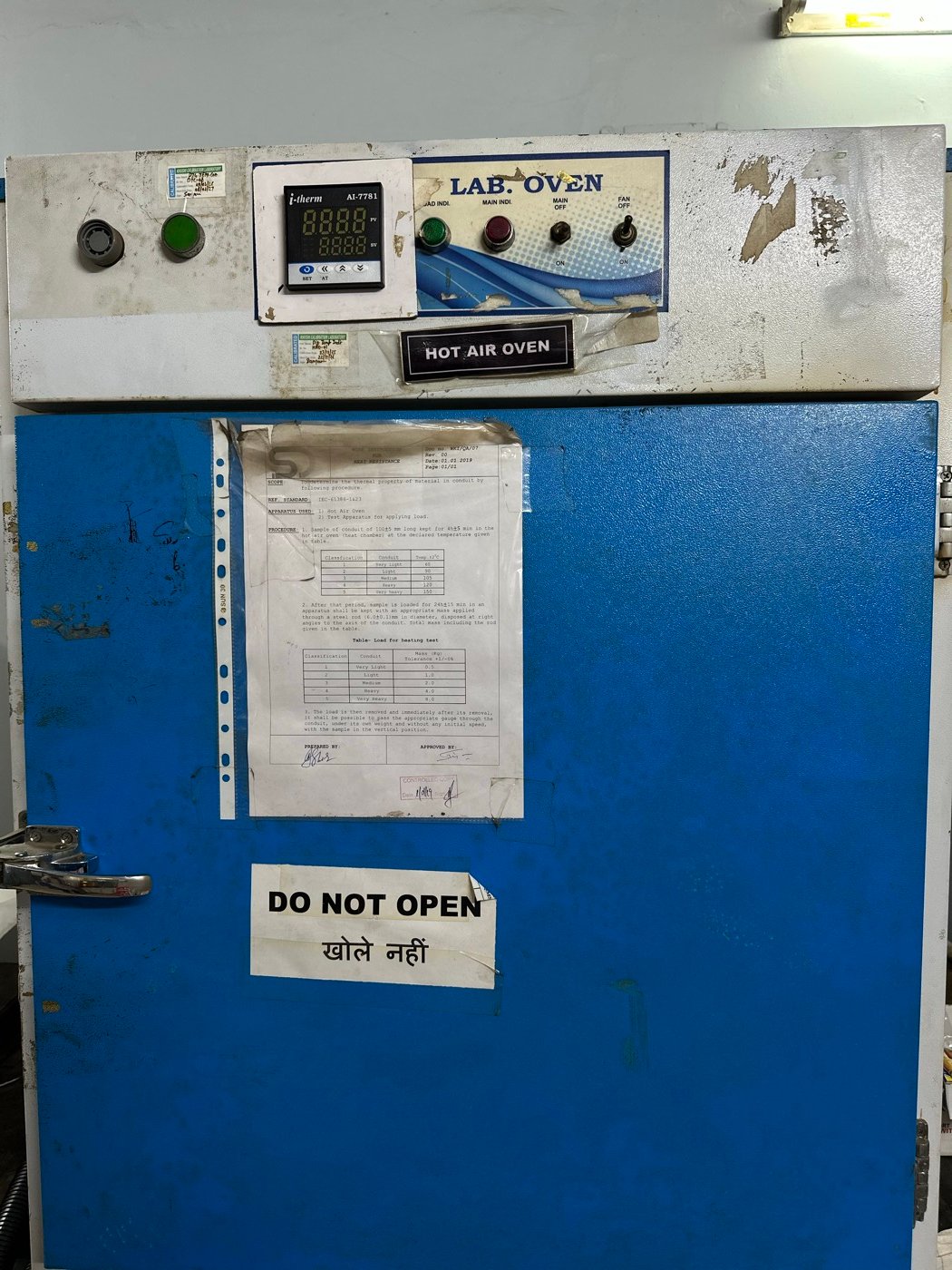
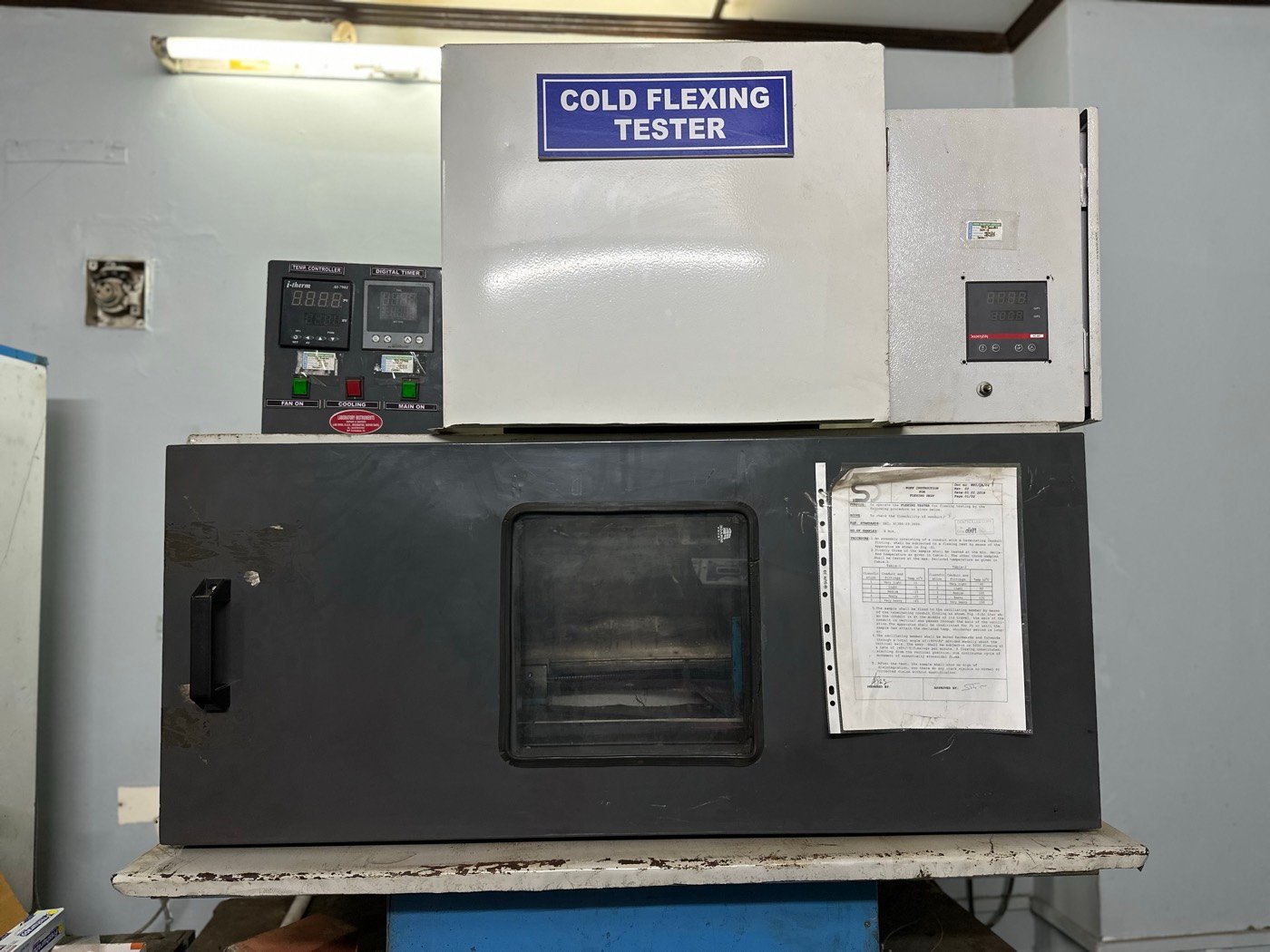
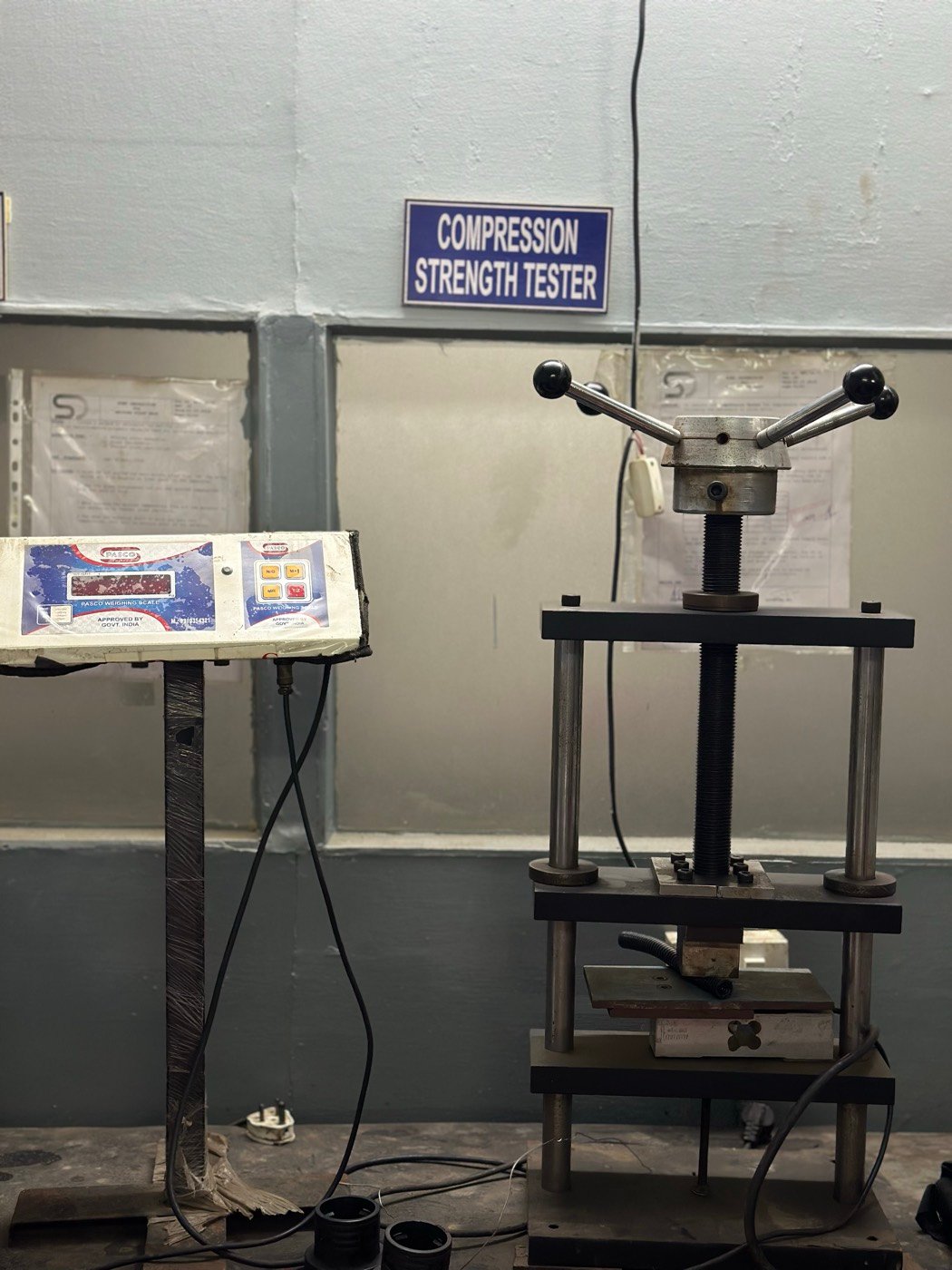
Before sleeving is spooled and labelled, a batch is checked against its specification. The checks are simple and quick, and they are the same ones we suggest customers use at goods-in in our documentation guide:
| Check | How | What it catches |
|---|---|---|
| Expansion range | Fit over mandrels at the minimum and maximum of the stated range | Wrong carrier count, wrong braid angle, wrong size |
| Weight per metre | Cut and weigh a measured length | Yarn or construction errors, missing carriers |
| Picks per unit length | Count crossings over a set length with a magnifier | Take-up speed drift |
| Visual | Inspect under good light | Fuzz, broken yarns, contamination, uneven heat-treatment colour |
| Length and label | Metered spooling; label with size, batch and length | Short spools; traceability errors |
Spool lengths depend on size: from 1,000 m on the smallest, 3 mm sleeve down to 100 m on the largest.
What this means when you read a data sheet
- The expansion range is a geometric property of carriers, yarn and braid angle. Two sleeves with the same nominal size from different makers can behave differently.
- Coverage and expansion are traded against each other. A sleeve braided for wide expansion covers less densely at the top of its range.
- Heat-treated and standard sleeves come from the same braid. The difference is the finishing step, which is why they share the same size ranges.
- Weight per metre is your best quick check that a delivery matches what you approved.
Frequently asked questions
How is expandable braided sleeving made?
Yarn is wound onto carrier bobbins and loaded into a maypole braiding machine. Two sets of carriers travel in opposite directions around a track, interlacing their yarns into a tube that is drawn away by a take-up mechanism. Heat-treated sleeving then goes through a heat-cleaning process to remove the textile size.
Why does braided sleeving get shorter when it expands?
The yarns don't stretch; they change angle. As the braid angle increases, the diameter grows and the length shrinks. Going from a 30° to a 60° braid angle increases the diameter by about 1.7 times and shortens the sleeve by more than 40 %.
Why is heat-treated fibreglass sleeving bronze?
The heat-cleaning process burns off the starch-oil textile size on the glass yarn. The remaining glass takes on a bronze or golden tone, which is characteristic of heat-treated glass textiles.
What sets the expansion range of a sleeve?
The number of carriers, the yarn size and the braid angle. The sleeve expands until the yarns jam side by side and contracts until they jam lengthwise; those two points define the range.
The bottom line
Expandable sleeving looks simple, but every metre depends on evenly wound bobbins, a well-set machine, careful handling of a brittle fibre and, for heat-treated grades, a tightly controlled finishing step. The geometry of the braid explains why sleeving expands, why it shortens when it does, and why sizing in the lower half of the range makes sense. Knowing how it is made is the best way to read a data sheet.
References
- Kyosev, Y. (ed.), Braiding Technology for Textiles, Woodhead Publishing, 2014.
- Thomason, J. L. et al., research on the strength of thermally conditioned glass fibres, University of Strathclyde.
- IARC Monographs, Volume 81, Man-made Vitreous Fibres (2002).
Where this shows up in the catalogue

Have a specification question?
Send your application details and we'll help match the right product and configuration.
Want to see it for yourself?
Customers are welcome to visit our braiding floor in Faridabad. Arrange a visit or ask a technical question through our enquiry form, or see fibreglass expandable sleeving sizes.